Table of Contents
What Is A Risk Assessment
A risk assessment is a structured method that allows you to systematically identify all possible hazards of a product. You analyse the risks that may arise during the use, maintenance or assembly of a machine, device or installation. Based on this analysis, you determine which measures are needed to reduce risks to an acceptable level.
A risk assessment therefore forms the foundation for safe products, correct manuals and a responsible production process.
Why Is A Risk Analysis Necessary
User safety is always paramount. European directives, such as the Machinery Directive (2006/42/EC), require manufacturers to carry out a risk assessment. Without a proper assessment, you risk not only accidents, but also legal liability, product recalls and reputational damage.
Benefits of such an assessment are:
- You ensure the safety of the end user
- You comply with legal requirements
- You prevent costly modifications afterwards
- You reduce the risk of claims and liability
- You improve the quality and reputation of your product
A well-executed risk assessment leads to clear and understandable instructions. As a result, your product becomes both safe and user-friendly.
European Standards And Risk Evaluation
European directives set safety requirements, but do not always specify how to achieve them. Standards provide practical guidance and translate legal requirements into concrete actions. Harmonised European standards, such as EN ISO 12100, describe the general process and key considerations for performing a risk assessment.
Standards are divided into three types:
- Type A Standards: These define fundamental safety principles and provide a general methodology for risk assessment and risk reduction. EN ISO 12100 is the main example.
- Type B Standards: These address general safety aspects or protective measures applicable to different machines. They are divided into:
- B1 Standards: General safety aspects, such as safe distances and ergonomics
- B2 Standards: Specific protective measures, such as emergency stops or guards
- Type C Standards: These contain specific safety requirements for particular machine groups. They describe hazards, risk reduction measures and user instructions tailored to a specific category.
This classification helps you identify hazards and define appropriate measures for each product. Type C standards often include tables or descriptions of hazards and corresponding protective measures, providing practical guidance for compliance.
Example: Risk Analysis For A Hedge Trimmer
In the C standard for electric hedge trimmers (EN ISO 10517), you will find a list of relevant hazards, such as mechanical, electrical and thermal risks. For each hazard, recommended measures are defined, for example two-hand control to prevent cuts.
The standard also sets requirements for the user manual, including clear instructions and warnings. This creates a direct link between the risk assessment and practical safety instructions.
The Risk Assessment Process
A risk evaluation follows a fixed structure. This ensures that no steps are missed and that all relevant hazards are considered.
Step-By-Step Plan
| Step | Activity | Action |
| 1 | Hazard Identification | Identify all possible hazards: mechanical, electrical, thermal, noise, radiation, hazardous substances, ergonomics, environment and combinations. Consult relevant standards. |
| 2 | Risk Analysis | Determine the risk for each hazard. This is often done using a risk graph, considering likelihood, severity of injury and exposure. |
| 3 | Risk Evaluation | Assess whether risks are acceptable. If not, additional measures are required. |
| 4 | Risk Reduction | Apply measures in the following order: Safe design: eliminate hazards where possible. Protective measures: guard or protect against hazards. Instructions and warnings: inform users about residual risks. |
| 5 | Documentation And Verification | Record the entire process and verify that risks are sufficiently reduced. |
Iterative Nature Of Risk Assessment
Risk assessment is not a one-time activity. Design changes or new applications can introduce new risks. Therefore, review and update your assessment regularly.
Effective Safety Instructions
Not all risks can be eliminated. Remaining residual risks must be clearly described in the manual. These instructions are part of the risk assessment and are essential for safe use.
Good Safety Instructions Meet The Following Criteria:
- Clearly Structured: use bullet points and a logical sequence
- Concrete Instructions: describe exactly what the user must do, the expected result and how to verify it
- Imperative Form: address the user directly and clearly (“Always wear safety gloves”)
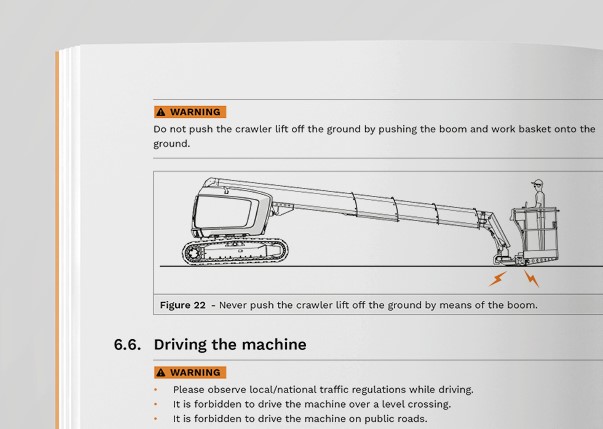
- Warnings And Signal Words: use terms such as “Caution”, “Warning”, “Danger” at the correct point in the procedure
Labels And Warning Symbols
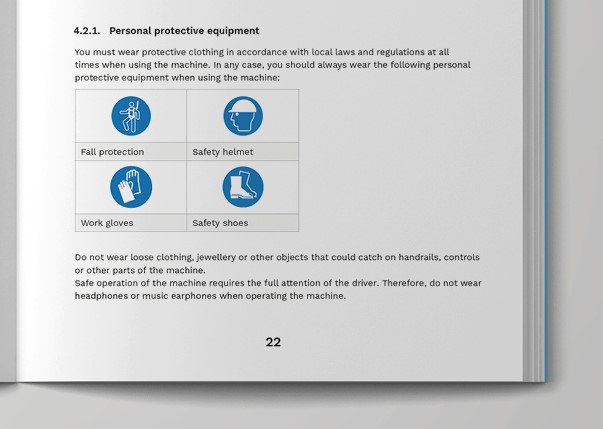
In addition to manuals, labels and pictograms on the product are important. They attract attention and provide critical information at a glance.
Two categories are distinguished:
- Operating Instructions: indicate correct operation, such as on/off symbols
- Warning Signs: highlight specific hazards, such as moving parts or electrical voltage
All symbols must be explained in the manual. In some cases, symbols are supported by warning texts that include:
- The nature of the hazard
- Possible injury
- How to prevent the injury
This creates a consistent set of visual and textual safety information.
Risk Assessment And The Role Of The Manufacturer
The manufacturer or designer is responsible for carrying out the risk analysis, preferably during the design phase. Define the limits of the product:
- Use Limits: intended and reasonably foreseeable misuse
- Spatial Limits: positions and geometric constraints
- Time Limits: expected lifetime and wear-sensitive parts
Include these limits explicitly in both the assessment and the manual. This helps prevent incorrect use.
Risk Analysis In Practice
In practice, a risk analysis is a team effort. Involve designers, engineers, safety experts and users. Use checklists and risk graphs as tools. Document all findings in a structured report.
What Does A Risk Graph Do
A risk graph combines factors to determine the risk level, such as:
- Severity of possible injury (minor, serious or fatal)
- Frequency of exposure
- Probability of occurrence
- Possibility of avoiding the hazard
This results in a visual classification of risk levels, such as low, medium or high.
Common Mistakes
Many errors arise from an incomplete or inconsistent application of the assessment process. An overview of common mistakes:
- Describing only residual risks without reducing them through design or protection
- Incomplete hazard analysis due to lack of multidisciplinary input
- Unclear instructions, leading to incorrect risk assessment by users
Avoid these pitfalls by following the process carefully and critically reviewing the outcome.
Support From An Expert
A professional risk analysis forms the basis for safety and efficiency. Manualise supports you in translating analysis results into clear safety instructions and integrating them into understandable, user-friendly documentation.