Table of Contents
What Is Product Safety Legislation in the USA
In the United States, product safety rules are established by federal agencies such as the Consumer Product Safety Commission (CPSC), the Federal Trade Commission and the National Highway Traffic Safety Administration. Once Congress adopts a product safety law, the responsible agency develops the associated regulations, sometimes based on existing standards.
Why Are There Multiple Agencies
The type of product and its use determine which agency is responsible. For consumer products, the CPSC is the most important authority. The CPSC protects consumers from risks of serious injury or death caused by products within its jurisdiction. This includes thousands of consumer products such as toys, tools, lighters and household chemicals. The CPSC focuses on fire hazards, electrical risks, chemical hazards and risks to children.
The Role of the CPSC
The CPSC was established by Congress through the Consumer Product Safety Act (CPSA). Under this law, the CPSC protects consumers by:
- Providing information and education
- Developing and enforcing safety standards
- Publishing regulations
- Monitoring compliance
Since 2008, the Consumer Product Safety Improvement Act (CPSIA) has also applied. This law imposes stricter requirements for testing and documentation. For example, it sets limits on hazardous substances and requires manufacturers to demonstrate compliance.
Obligations for Manufacturers and Importers
Under the CPSIA, every manufacturer or importer of consumer products covered by CPSC rules must provide a certificate confirming compliance with applicable standards. In some cases, products must be tested by an independent third party. It may also be mandatory to indicate the country of origin on the product and to carry out product recalls if necessary.
Enforcement and Reporting Obligations
The CPSC monitors whether products comply with regulations. In case of non-compliance, the agency informs the company and requests corrective action. Importers, manufacturers, distributors and retailers must inform the CPSC when a product:
- Does not comply with safety regulations
- Contains a defect that creates a hazard
- Poses a risk of serious injury or death
Regulated Products in the USA
Various federal agencies regulate product safety within the following categories:
- Health and personal care (alcohol, food, cosmetics, tobacco)
- Vehicles and vehicle-related products (aircraft, amusement rides, boats, cars)
- Hazards, safety and firearms (ammunition, industrial products, radioactive materials)
- Other products
To find the applicable requirements, first determine which federal agency is responsible for your product. This may involve multiple agencies.
Unregulated Products in the USA
If your product is not listed as regulated but falls under a specific agency, it is likely considered unregulated. These products are not subject to specific standards or bans. However, if an unregulated product is defective or dangerous, you must report it.
Companies must report in the following situations:
- Hazardous Products
If a product does not comply with safety rules, has a defect or may cause serious injury or death, the CPSC must be informed within 24 hours. - Legal Proceedings
Manufacturers must inform the CPSC about ongoing or completed legal cases involving their products.
Product Liability in the USA
There is no single federal product liability law in the United States. Each state has its own rules. Most claims are based on strict liability, where it is assessed whether the product is defective, or whether negligence, fraud or warranty issues are involved.
In the event of a claim, a test may be carried out to determine whether a product is defective. This involves assessing consumer expectations or conducting a risk assessment. There are three main reasons for defectiveness:
- Manufacturing defects
- Design defects
- Inadequate warnings
Failure to provide adequate warnings about known risks is considered a defect in warnings. Common problems include:
- Insufficient warnings or instructions
- Risks that could have been reduced through proper warnings or instructions
- Lack of warnings or instructions making the product unsafe
Investigations into design, warning and instruction defects are often subjective and are assessed by a jury. Manufacturers must determine how and when to provide warnings before placing a product on the market.
Manufacturers, component suppliers or importers may all be held liable caused by a defective product. As in the EU, the injured party must prove that the defect caused the damage.
Federal Regulatory Framework and Instructions
The federal regulatory framework also affects product instructions. Mandatory regulations and voluntary standards may lead to product-specific requirements for instructions.
A widely used standard for instructions for use is IEC 82079-1. This standard provides guidelines for clear and usable user information.
Warnings
Warnings are particularly important in the United States due to court rulings. Manufacturers are required to warn of product risks if:
- The product is dangerous
- The manufacturer is aware of the hazard
- The hazard occurs during normal use
- The risk is not obvious to the user
A warning is considered inadequate if harm could have been prevented through clear instructions or warnings. Instructions alone are not sufficient. Warnings are necessary to draw attention to risks.
Manuals describe correct and safe use. Warnings indicate what users must not do, or must always do, to avoid danger. Standards such as ANSI Z535.6 define requirements for the content, placement and presentation of warnings.
Key Differences Between the EU and the USA
- The US does not use CE marking.
- In the EU, there is a single established procedure for compliance with legislation: following the steps for CE marking. In the US, the steps to be taken depend on the type of product and the responsible federal agency.
- In the US, agencies both set rules and enforce them; in the EU, directives are established by the European Commission (centrally), while enforcement is carried out by national authorities (locally).
- In the EU, new directives are developed from the ground up. In the US, product regulations are based on federal laws adopted by Congress.
- Standards in the EU are generally voluntary; in the US, they may be mandatory.
- US states may impose stricter rules than federal law; EU rules are harmonised across all Member States.
- In the US, court rulings (“case law”) impose a general obligation to warn of product risks.
These differences affect manuals. In the US, mandatory standards must be strictly followed, and warnings play a central role. In the EU, directives are mandatory, while standards are generally voluntary.
Companies exporting between the EU and the US must consider these differences to ensure compliance and limit liability.
Steps to Comply with US Legislation
Companies that manufacture, import or distribute consumer products in the United States must comply with various laws and regulations. The required steps depend on the product and the responsible agency.
For products under CPSC jurisdiction:
- Determine whether the product is intended for children
- Identify applicable regulations
- Establish testing and certification requirements
- Check mandatory labelling requirements
- Identify reporting obligations
Steps for Preparing Compliant Instructions
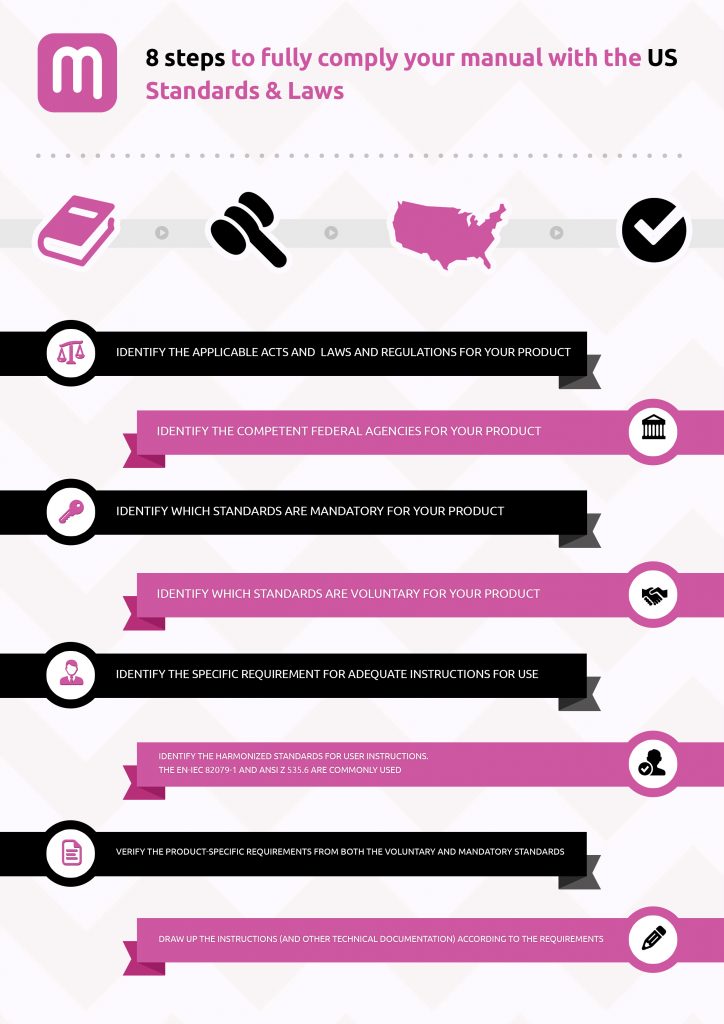
- Identify applicable legislation
- Determine the responsible federal agency
- Identify mandatory standards
- Identify voluntary standards
- Extract requirements for instructions from these standards
- Consult relevant standards for instructions (such as IEC 82079-1 and ANSI Z535.6)
- Verify product-specific requirements
- Prepare instructions and technical documentation in line with these standards
By following these steps, you ensure that your documentation meets US requirements and supports safe product use.