Table of Contents
What Is Content Management
Content Management is the process of collecting, organising, managing and maintaining information in any format. Information is stored centrally, structured logically and controlled throughout its lifecycle.
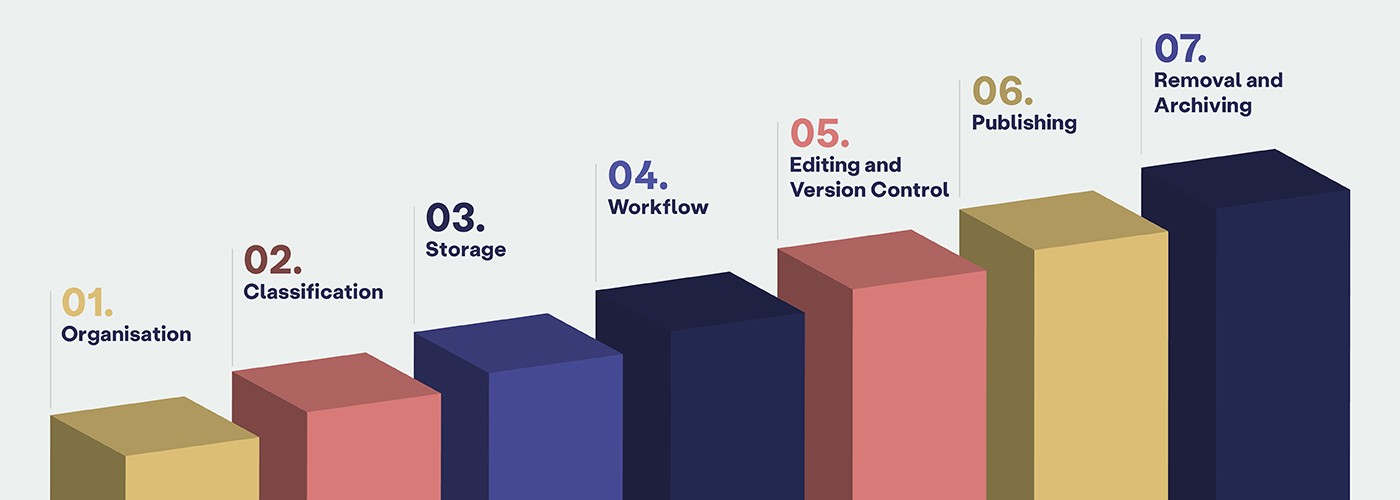
The Content Management process typically consists of seven phases:
- Organisation
- Classification
- Storage
- Workflow
- Editing and Version Control
- Publishing
- Removal and Archiving
Instead of managing separate documents, organisations use a single environment in which all elements of a manual come together. These elements may include procedures, safety warnings, illustrations and information about product variants.
By storing content in a structured way, organisations create a reliable source of information. Content can be reused, updated or expanded quickly. As a result, documentation remains consistent and manageable, regardless of the number of products, languages or departments involved.
This central environment typically relies on specialised software called a Content Management System (CMS). For technical documentation, organisations often use a Component Content Management System (CCMS). In such systems, content is divided into small, reusable components that can be managed independently.
Want to learn more about CMS systems? Read our article “Creating Manuals Efficiently with a CMS” or watch our video about managing documentation efficiently.
How Content Management Supports the Entire Organisation
Information management is not the responsibility of a single team. It affects nearly every department involved in the development, production and support of a product.
By working from a single, central source of information, organisations ensure that product documentation remains clear, reliable and up to date. This leads to better manuals, lower operational costs and an improved customer experience.
Below is an overview of how different departments benefit from Content Management.
Product Development and Engineering
Content Management ensures that technical information is captured and stored correctly. Manuals remain complete and accurate, while engineers spend less time answering documentation-related questions.
Product Management
Product managers often deal with multiple product variants. Content Management prevents this from leading to dozens of separate manuals. Variations remain manageable and product releases can be documented more efficiently. This makes it easier to meet deadlines.
Technical Writers
When content is centrally structured, technical writers can work faster and more consistently. They can reuse existing information, update individual components easily and publish it in a controlled manner.
Quality and Compliance
Content Management ensures the traceability of changes. Updates to documentation are recorded and managed in a controlled manner. This keeps information demonstrably up to date and, for example, prevents outdated safety warnings or instructions from reappearing in publications.
Service and Maintenance
Service teams work more efficiently when they have access to accurate and up-to-date information. They can diagnose and resolve problems more quickly and perform their tasks more safely. Feedback from field operations can be recorded and incorporated into the documentation, ensuring manuals reflect real-world usage.
Marketing and Communication
Content Management ensures that all teams use the same terminology, writing style and visual guidelines. This improves consistency across all communication channels, from product brochures to online manuals.
Translation and Localisation
Translation and localisation processes become more efficient and controlled. Only content that has changed needs to be translated again. This reduces translation costs and prevents inconsistencies between language versions.
Management and Leadership
For management, structured information management represents a strategic investment. It increases operational efficiency, reduces risks and supports a professional brand image. At the same time, it creates a scalable documentation framework that can grow with the organisation.
Terminology Management
Consistent terminology is essential for clear communication. It prevents misunderstandings and improves both the clarity and safety of manuals.
With terminology management, organisations maintain a central list of approved terms. These may include product names, technical concepts and safety labels. By defining terms centrally, organisations prevent departments from using different variations that could confuse users.
When all teams use the same terminology, information becomes easier to recognise and process. This benefits technical writers, engineers, marketing teams and service staff alike.
Translators also benefit from a central terminology database. They can immediately see which terms are fixed and how they should be translated. This ensures consistency across languages and improves the quality of multilingual documentation.
Content Management for International Markets
Organisations operating internationally must manage multiple language versions and regional documentation requirements. Content Management helps organise these variations efficiently. Translated content is linked directly to the source content, so only modified sections need to be translated again. This reduces both translation time and costs.
Regional or market-specific information can also be managed separately without affecting the main documentation. For example, instructions for the US market can remain distinct from European requirements while still being managed within the same structured environment.
This approach ensures that documentation remains consistent and reliable across global markets.
Documentation as Part of the Customer Experience
For many users, the manual is the first source of support. Clear documentation improves usability and contributes to a positive product experience. Information management ensures that documentation remains consistent across all channels. Whether users consult an online manual, a mobile application or a downloadable PDF, they encounter the same information, terminology and structure.
As a result, good documentation supports not only safe product use but also a strong overall customer experience.
Your Manuals: Getting Started with Content Management
It’s clear: Content Management provides a strong foundation for clear, safe and consistent documentation. By managing content centrally, organisations gain better control over information, versions, terminology and international variations.
Would you like to improve your documentation process? Manualise can help you set up and optimise Content Management within your organisation.