Table of Contents
What Is Technical Writing
Technical writing involves more than simply producing text. It has many applications and plays a crucial role across various sectors. Regardless of the context, the goal is usually the same: to present complex information in a clear, structured and accessible way.
Examples of technical writing include:
- User documentation, such as manuals and online help files
- Software documentation
- Training materials
Technical writing is also used to develop legal documentation, as well as marketing and sales materials.
However, technical writing goes beyond writing alone. It involves analysing information, structuring content, creating visuals and optimising usability. It combines language, technology and user focus. In short, technical writing is far more than putting words on paper.
How Do You Write Technical Documents
Let us take user documentation as an example. User documentation includes all information a user needs to understand a product or system and to install, operate and maintain it safely and correctly. It also supports users in solving potential problems.
In this context, technical writing covers the development of installation manuals, quick start guides, software instructions, safety documentation and training materials.
Whether you create printed manuals or digital help files, a structured approach to defining the content is essential. In technical writing, this process usually includes the following steps:
- Identify the target audience
Determine who the documentation is intended for. In user documentation, this may be a technician, a consumer or an employee within an organisation.
Assess the user’s level of knowledge and adjust the terminology, tone and level of detail accordingly. - Collect product information
Go beyond simply testing the product. Consult subject matter experts, such as product developers or engineers, as well as end users. Their insights help you identify practical issues and essential details.
Also review applicable legislation, standards and guidelines. These may impose specific requirements on the content and structure of the documentation. - Write and illustrate the documentation
Ensure that the content is consistent, concise and tailored to the target audience. Use clear language and avoid unnecessary complexity.
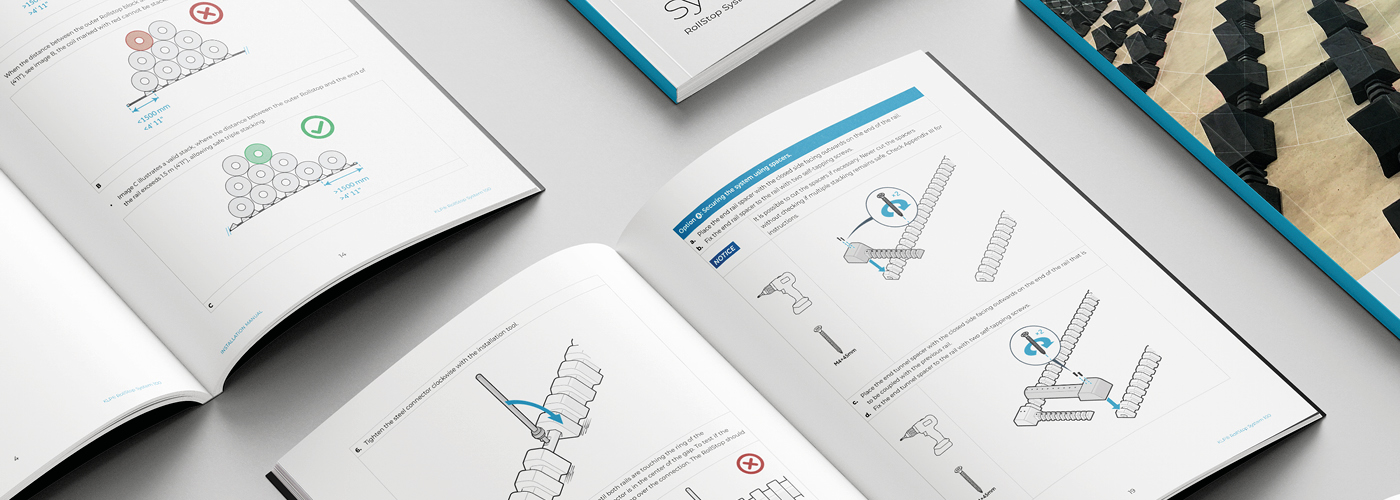
Support the text with technical illustrations where needed. Visual elements help make complex information accessible and easier to understand.
A logical structure, accurate content and a consistent layout form the foundation of high-quality technical documentation.
If the documentation must be available in another language, work with a technical translator. This ensures that the translated version remains accurate, consistent and easy to understand.
Simplified Technical English (STE): A Method for Writing Documentation
Are you starting with technical writing? A useful tool is Simplified Technical English (STE). STE is a standardised writing method for technical documentation. It was originally developed for the aviation industry, but is now applied in many other sectors.
The objective of STE is to make technical documentation clearer and easier to understand. In industries where safety is critical, ambiguity or unclear wording can have serious consequences. STE reduces this risk by using a controlled vocabulary, standardised terminology and clear sentence structures.
Example and Basic Rules
Consider the sentence: “Handle with care can break.”
This sentence can be interpreted in two ways:
- Handle this object carefully, as it can break.
- The object can break if you handle it with care.
The second interpretation creates confusion and even contradiction.
In Simplified Technical English, the sentence would be rewritten as:
- “Handle with care. It can break.”
- “Be careful. This item is fragile.”
These versions remove ambiguity and clearly communicate the intended meaning.
STE applies several basic rules. Examples include:
- Use one preferred term consistently.
When multiple synonyms exist, select one and use it throughout the documentation. For example, instead of alternating between begin, commence, initiate and originate, STE prescribes the use of start. - Use words with only one defined meaning.
In STE, the word fall is used only to describe something dropping due to gravity. It is not used to indicate a decrease in size, number or force. This restriction prevents misunderstanding. - Avoid words with multiple grammatical functions.
In general English, switch can be both a noun and a verb. In STE, switch is used only as a noun. For the verb, use turn on or turn off instead.
By applying these rules, you improve clarity, reduce ambiguity and increase safety.
For more information about Simplified Technical English, visit the official STE website.
What Does a Technical Writer Do
In short, a technical writer ensures that information is not only technically accurate, but also clear, compliant and usable.
Technical writers specialise in collecting, analysing and presenting complex information in a clear and structured way. The goal is to ensure that the content matches the needs, knowledge level and expectations of the target audience.
Depending on the sector, the technical writer adapts the language, terminology and level of detail. Technical information must be accessible not only to experts, but also to users with limited prior knowledge. Clear structure and precise wording are therefore essential.
Creating Clear Visuals
An important part of presenting information is the use of technical illustrations. Visuals help users understand complex concepts more quickly and reduce the need for lengthy explanations.
Technical illustrations must be:
- Clear and simple
- Consistent in style
- Aligned with relevant industry guidelines
A technical writer limits the amount of text within illustrations and ensures that images support the written instructions effectively.
Managing Technical Documentation
In addition to analysing and presenting information, a technical writer is responsible for managing documentation. In organisations that develop complex products and must comply with technical and legal requirements—such as in mechanical engineering, the automotive sector or the pharmaceutical industry—the technical writer plays a key role.
For example, they contribute to the preparation and maintenance of a Technical Construction File. This file contains all required documentation to demonstrate compliance with applicable legislation and standards.
Technical Construction File (TCF)
A TCF, also called a Technical File, is a collection of documents demonstrating that a product complies with relevant legislation and regulations. This file contains all the technical and administrative data relating to the design, manufacture, and operation of a product. It is for internal use only and is mainly intended for inspection bodies. A TCF is required for products that fall under CE directives.
A technical writer helps ensure that all relevant product information is correctly documented, so a TCF is complete, clear, and legally compliant. This technical documentation includes user manuals, technical specifications, risk analyses, test and inspection reports, and maintenance and installation instructions. It must meet certain standards, such as the Machinery Directive (2006/42/EC) or the Low Voltage Directive (2014/35/EU).
Manualise Can Help if Technical Writing Is a Challenge
Are you starting with technical writing for the first time? Or would you like to improve your existing technical documentation? Manualise provides comprehensive support in developing and professionalising your documentation.
We assist you with compliance checks to determine which legal and technical requirements apply to your documentation. We also support you in writing clear instructions and creating effective technical illustrations.
Our technical writers ensure that your documentation is accurate, structured and tailored to your target audience.