
Table of Contents
What Is an Installation Guide
An installation guide explains how a product must be connected, configured or installed in the environment where it will be used. A common example is the installation of a central heating boiler.
An installation guide does more than describe the required steps. It also functions as a verification tool. Installers can follow the guide step by step and check whether all connections and settings have been completed correctly. The document is therefore essential for proper operation and for ensuring safety.
In the case of a central heating boiler, an installation guide is used to:
- Describe how the boiler must be connected to the gas supply, water pipes, flue system and electrical network
- Explain step by step how to set the system pressure and bleed the installation
- Clarify any software commissioning or configuration procedures
Equally important, the installation guide must:
- Warn against risks such as carbon monoxide poisoning or gas leaks
- Comply with applicable installation regulations, national standards and building requirements
An installation guide should not be confused with an assembly guide. An assembly guide explains how to physically assemble a product or secure it to a fixed surface, such as a wall or floor. In this example, the assembly guide would describe how to mount the boiler correctly on a wall or inside a cabinet.
Sectors That Commonly Use Installation Guides
In almost every sector where technical products must be connected or integrated on site, an installation guide ensures correct and safe installation, configuration and connection.
Examples of sectors in which an installation guide is essential include:
- Technical installations and mechanical engineering
For example central heating boilers, ventilation systems, heat pumps and air conditioning units. The objective is correct connection to gas, water, drainage and electricity, while safeguarding safety. - ICT and electronics
For example servers, routers, smart thermostats and home automation systems. The objective is fault-free connection, configuration and integration into existing networks. - Electrical engineering and energy
For example solar panels, charging stations, inverters and distribution boards. The objective is installation in accordance with electrical standards and prevention of short circuits or fire hazards. - Construction and infrastructure
For example fencing systems, automatic gates and alarm systems. The objective is correct connection to power supplies and control networks.
For many of these products, the installer first positions and secures the product before connecting it. When assembly and installation are combined in one document, it is generally referred to as an installation guide in practice. - Consumer electronics and white goods
For example washing machines, smart doorbells, security cameras and home cinema systems. The objective is to enable correct use while complying with installation requirements.
How Do You Write a Good Installation Guide
Are you about to write an installation guide and unsure where to start? A structured approach is essential. In practice, the following steps are usually followed.
- Define the Target Audience
An effective installation guide matches the user. Is the reader a professional installer, a skilled consumer or an IT technician? Determine the user’s level of knowledge and technical background. Adjust the terminology, level of detail and visual support accordingly. - Gather Product and Installation Information
A clear installation guide requires thorough knowledge of both the product and the installation process. Collect information from:- Designers, developers or engineers
- Experienced installers or testers
- Applicable regulations and standards relevant to your product and the documentation (for example NEN5509 for drafting user manuals)
Standards and guidelines may impose specific requirements on the installation guide, particularly regarding safety and warnings. - Write and Illustrate the Installation Guide
Structure the instructions in a logical sequence. Use concise sentences and clear wording. Apply the following principles:- Use active instructions, for example: “Insert the plug into the socket.”
- Provide visual support, such as step-by-step illustrations or pictograms, to clarify complex actions.
- Include clear warnings for hazardous actions.
A consistent structure, uniform terminology and a recognisable illustration style contribute to a professional and safe installation guide.
If translation is required, work with a technical translator to ensure that each language version remains accurate and clear.
What Does an Installation Guide Contain (Including Free Word Template)
In addition to a structured writing process, the content of the installation guide is crucial. Although the exact content depends on the product, a complete installation guide usually contains several fixed components.
Below you will find an overview with a brief explanation of each element.
Even easier: download our free Word template, in which we have already incorporated these components for you.
Standard Components of an Installation Guide
A complete installation guide usually includes the following components:
- Title page with document title and version control
- Preface introducing the product or system and defining the target audience
- Table of contents for clear navigation
- Introduction describing intended and unintended use, applied symbols and specific terminology
- Product description including one or more labelled images and relevant technical specifications
- Safety instructions outlining clear and detailed safety requirements
- Installation instructions, divided into logical subsections for easy navigation
- Troubleshooting with common problems and corresponding solutions
- Disposal instructions explaining how to dispose of the product responsibly
These components ensure that the installation guide is complete, structured and compliant.
Example of a Good Installation Guide
A strong installation guide is primarily visual. Illustrations often communicate information more effectively than text. They help users understand procedures faster and reduce the risk of errors.
Consider the following example.
The bolts of a generator must be replaced every two years to prevent loosening due to vibration. The guide states:
“Remove the bolts and reinsert the same type of bolts.”
This sentence may cause confusion. Should the installer use new bolts of the same type, or reinstall the old ones?
A simple illustration removes this ambiguity. Used bolts are shown being discarded, while new bolts are taken from a clearly labelled box. The message is unmistakable: always use new bolts.
Illustrations: Instruction and Checklist
Illustrations do not only show what must be done. They can also function as a checklist.
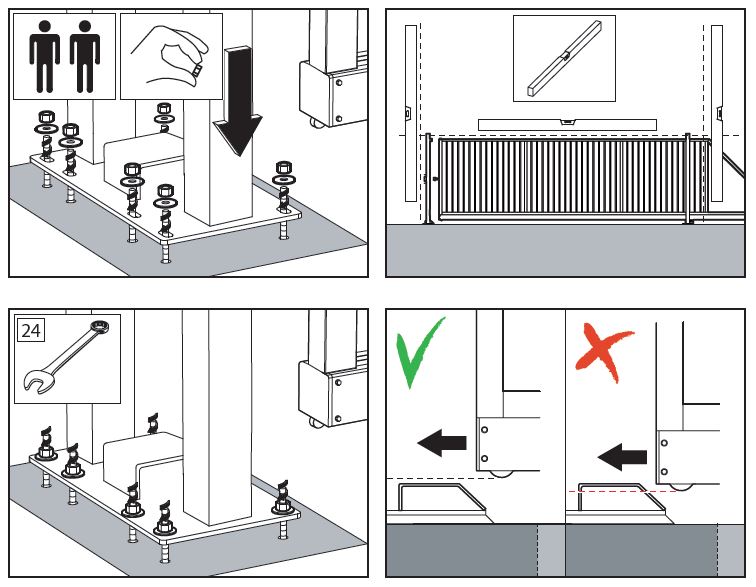
Consider an installation guide for a sliding gate:
- The top-left image shows a component being positioned and secured with bolts.
- The top-right and bottom-left images display the required tools, such as a spirit level and spanner.
- The bottom-right image shows a green tick for correct positioning and a red cross for incorrect placement.
This combination allows the installer to perform each step and immediately verify that it has been completed correctly.
Creating a Manual
In summary, an installation guide ensures safe installation, correct operation and compliance with applicable regulations. It guides installers step by step and helps prevent errors and unsafe situations.
A clear structure, consistent terminology and effective illustrations improve usability and efficiency. With a professionally developed installation guide, you lay the foundation for safe use and reliable product performance.
Would you like support? Manualise will be pleased to assist you in developing clear, efficient and user-friendly installation guides tailored to your product and market.